I am not sure there is one coherent pattern to everything – maybe there is. But I do know that human beings tend to be attracted to inherent symbolism and truths. We look for patterns; they are often just below the surface. Some are quite mysterious to us and remain so. There are works of art we still don’t fully understand but are drawn too.
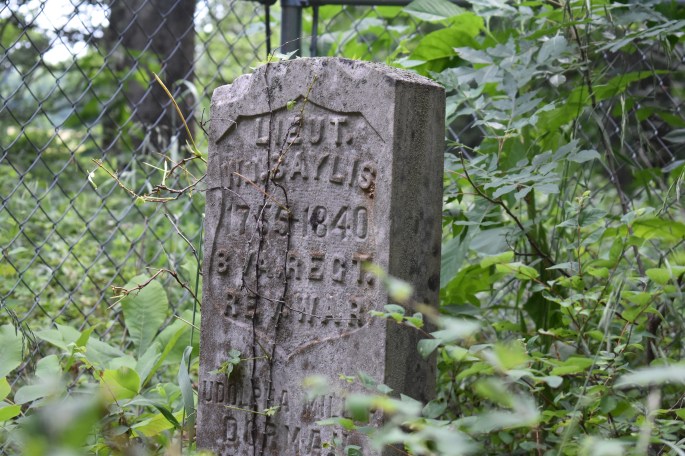
Today I want to share with you a photograph of a unique gravestone. What makes it unique is it’s location: it is the only known grave in my county (in a small town in Missouri) of a Revolutionary War Soldier. The story of William Baylis is quite fascinating in and of itself. But what struck me as interesting was the state of the grave marker and the background of the picture. To me it represented a deeper meaning about our relationship as Americans to our founding principles and ideas and the force of Nature (I mean that as nature in all aspects, including human nature). Note the man made components and the naturally occurring elements in the photo. Also, know that his grave is in a field that still has cattle ran in it.
In
1916, his grave was restored and a marker placed over his original headstone by
the Daughters of the American Revolution. Since that time, periodic attempts to
clean off the vines growing about or cut the saplings around his grave have
occurred. While I was photographing the tombstone, I even took out my pocket
knife and cleared some of the growth back. But, largely the grave site is
forgotten. It is not in a very accessible place and is rarely frequented except
by a few people who know where it is. I’m not sure if that is good or bad.
Perhaps, in the long run, a little cleaning and restoration of a barrier is
more profitable to its preservation than having an immediate access to it that
is unguarded or watched. I am personally torn in that regard because I believe
history should be available to any seeker; yet I also know not all seekers are
benign. Unfortunately, some people just do not respect the sanctity of some
things.
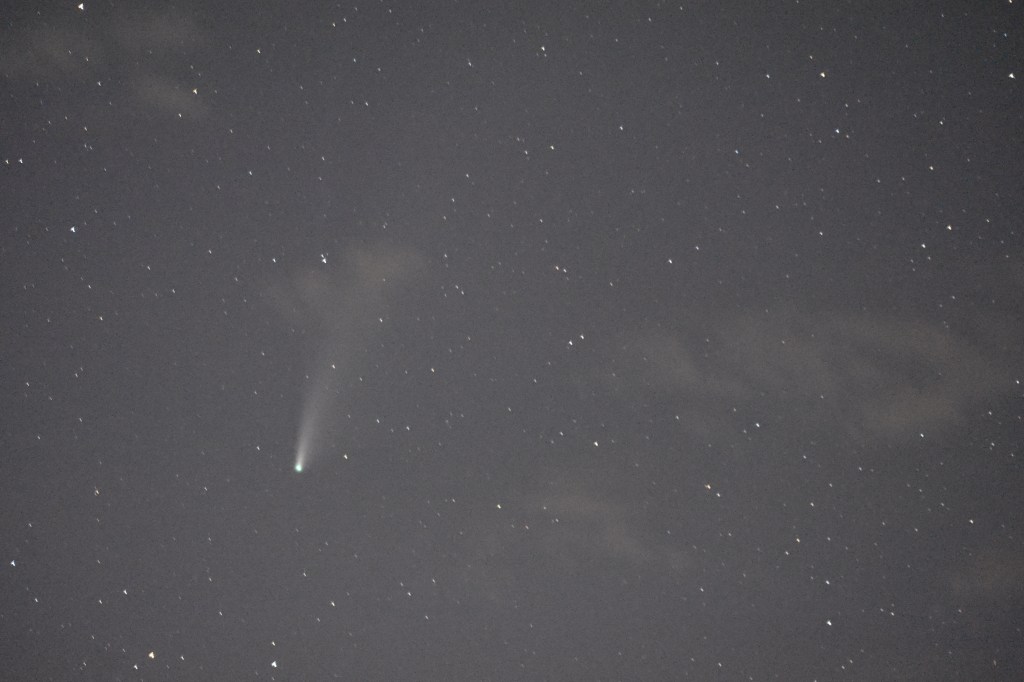
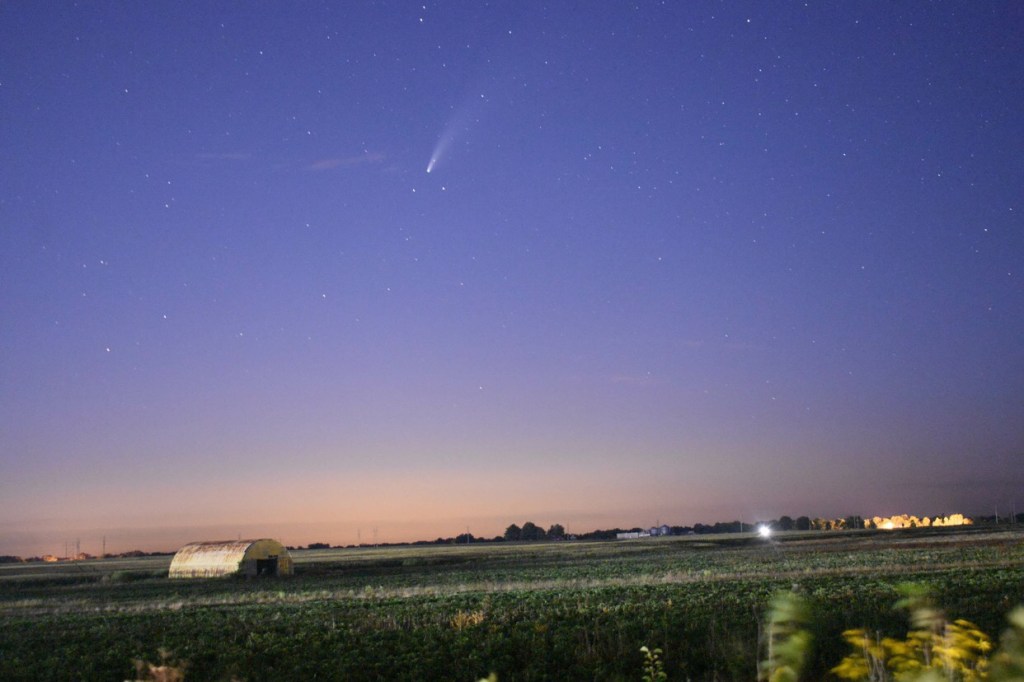
The universe is so large and we are so small. One of the more positive experiences I have had with photography is figuring out time exposure; it is personally rewarding for some reason. And, one of the best directions to point a camera to experiment with time exposed photos is the night sky.
The photos here (below) were the result of me setting up outside on a chilly October night trying to get a lucky shot of a shooting star. It was a prime opportunity, for sure: debris from Halley’s Comet has graced our night skies yearly in the form of meteorites, and the Orionids meteor shower can produce some surprisingly bright objects for viewing. As it is, I only saw one shooting star and did not even capture it on film. Once the night got cold enough, I folded up my tripod and headed back indoors.
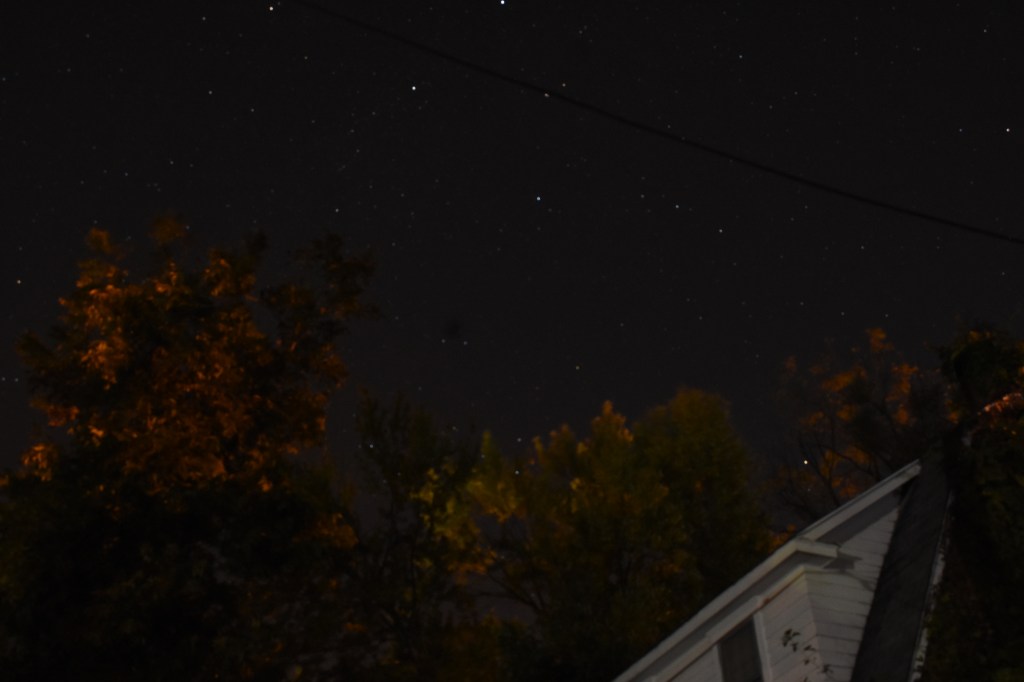
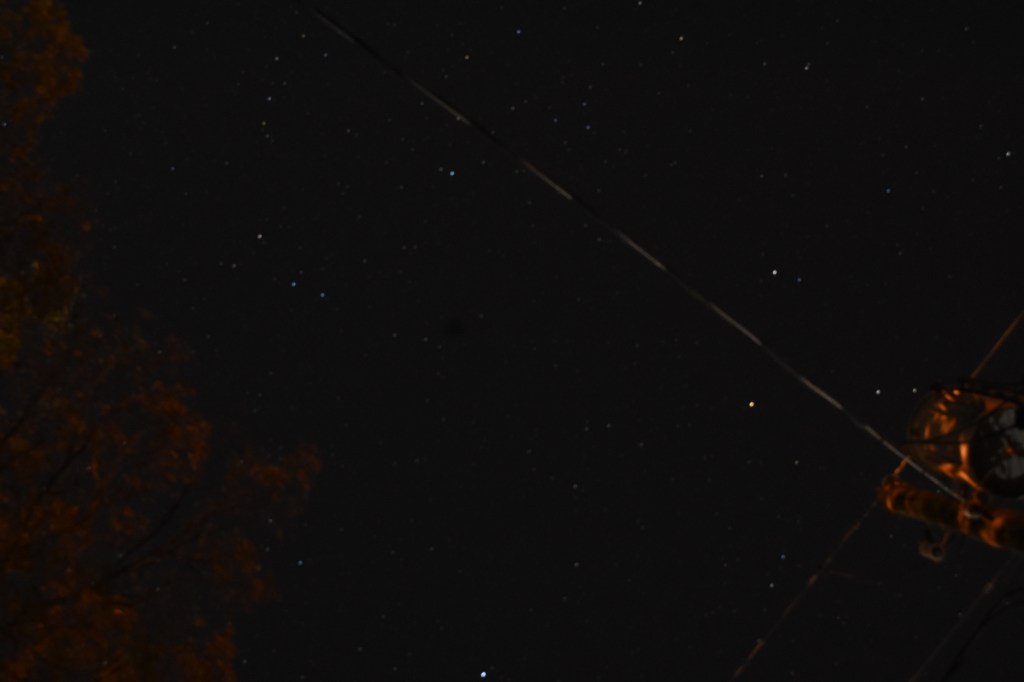
I did get some night sky pictures. Here are three: the first is a picture of Cassiopeia with the corner of a tree captured along with it. The second is a photo of the night sky with an abandoned house in the foreground; part of the constellation Pisces is peeking through the treetops. The third is a shot straight up from the ground (actually I laid my camera on an old stump); not only is a bit of the starfield capture, but also a power line and transformer from a telephone pole. Light pollution is all three photos was unavoidable, but made them a little more interesting in a way.
Cassiopeia (in the center) over a treeA Portion of Pisces peeking through some trees; an abandoned house in the foregroundStarfield with powerlines, telephone pole and transformer in the foreground. And a tree. Considerable light pollution during the pic.
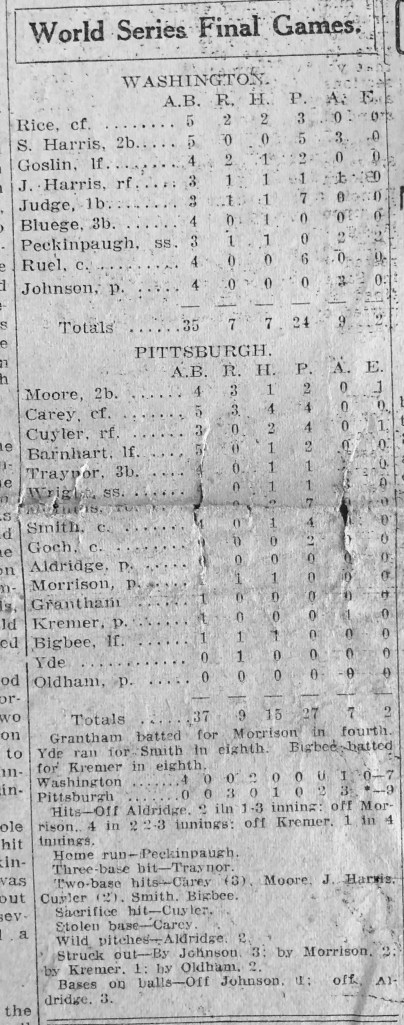
I run across a lot of neat things working at a newspaper. For instance, a woman donated some old newspaper clippings to us here at the paper not long ago. There is a lot of World War I and various miscellany of the few decades surrounding that time period in the stack she brought up. Interestingly, a clipping on the back of one of the preserved articles was what got my attention: “Pirates beat Griffs for Baseball Title: Cuyler’s Double in Eighth Wins Last Game and World Championship.” It was, of course, a portion of an article for the 1925 World Series game. One thing that I could discern from the article, is that sports writers are very much the same now as they were then: good sports writers are – whether you want to admit it or not – better journalists than many a beat reporter or paid writer for national news publications. Their work is precise, witty, often humorous, and pleasant to read. I wish there was a national day of “switch news writing” when all sports journalists could write an article or two for a national event. I think the public at large would be surprised – and probably pretty satisfied. Sports writers get lost in the details and the details support their opinions and perceptions.
Stat column from the 1925 world Series…
At any rate, the 1925 World Series between the Pirates and Washington Senators was a thriller. “Never before, except perhaps many years ago, was a contest played under such terrible conditions,” says the article writer William Becker, who goes on to describe rainy conditions so bad (yes, they kept playing, too – in the rain, battling right through it like champs, folks), that they had to frequently wipe down bats and hands with towels and spread sawdust out on the pitcher’s mound so Walter Johnson (yes, that Walter Johnson) could pitch through the eighth inning. So he could, “…twirl that heart-breaking eighth inning,” as Becker put it.
The Pirates had a great season in 1925: they went 95 – 58 in a season that saw outfielder Kiki Cuyler hit 26 triples, and infielder Glenn Wright get an unassisted triple play (in May). The Senators, at a 96 – 55 season, were in pretty good shape, too, and the World Series was a showdown: mother nature, however, showed them both up on the final game of a series that went to seven.
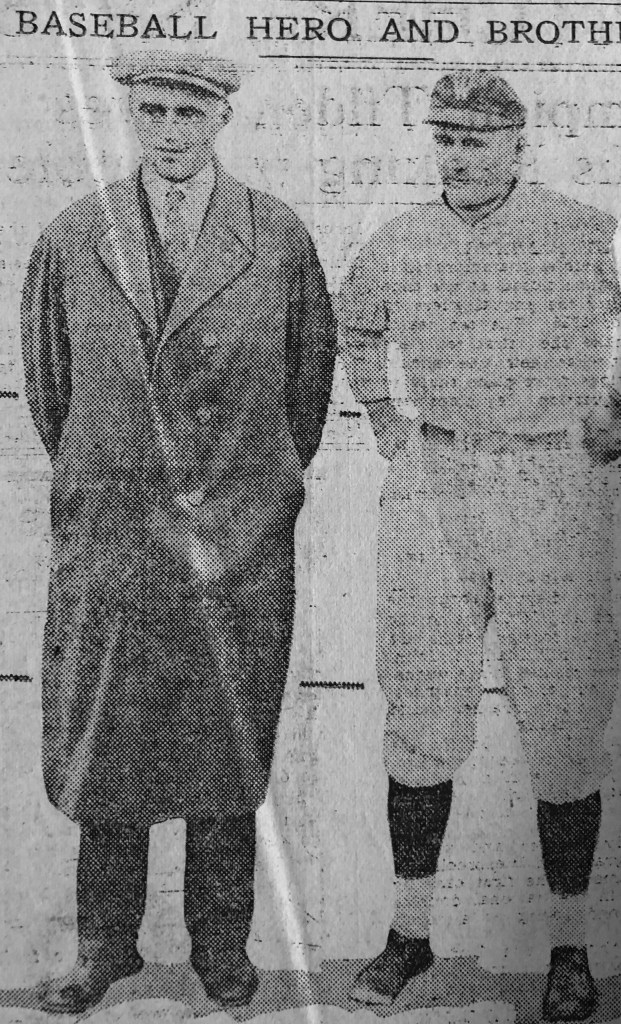
Baseball great Walter Johnson (right) and his brother (from 1925 newspaper clipping).
The conditions at Forbes Field were, as mentioned above, terrible. Rain and lighting were bad: “So dark the outfielders were invisible.” That, folks, is a baseball game. Red Oldham, the closing pitcher for the Pirates, got the save. But a lot of people were there just to see if Walter Johnson could hold out nine innings. “They begged [the crowd] and pleaded until their spirit and confidence were communicated [to Johnson].” That is a crowd getting into a game: this is before stadium lighting, it is raining something terrible out, and no one is leaving the ball park. There is saw dust on the mound, bats and hands are wet, and the Washington fans are mainly concerned with Johnson “going the distance.” The only homerun hit in the game was Washington Senator Roger Peckingpaugh (we do not have the great names in baseball as much as we used to, either: for example, Red Oldham, Goose Goslin, Stuffy McInnis, or Mule Haas), which attests to great pitching and really *****y weather. It had been raining most of the morning, anyway – and, no one cared: they were going to watch the game – and the game was going to be played. “While customers in what is called, and once was the ‘sun field’, watched the passing of threatening clouds, a crew of workers administered first aid to the drenched infield.” And this would have been cool, too: “Part of the crew burned gasoline on the runways [baselines] and succeeded in removing the water and drying up the diamond somewhat.”
Don’t you want to go back and see this game, folks?
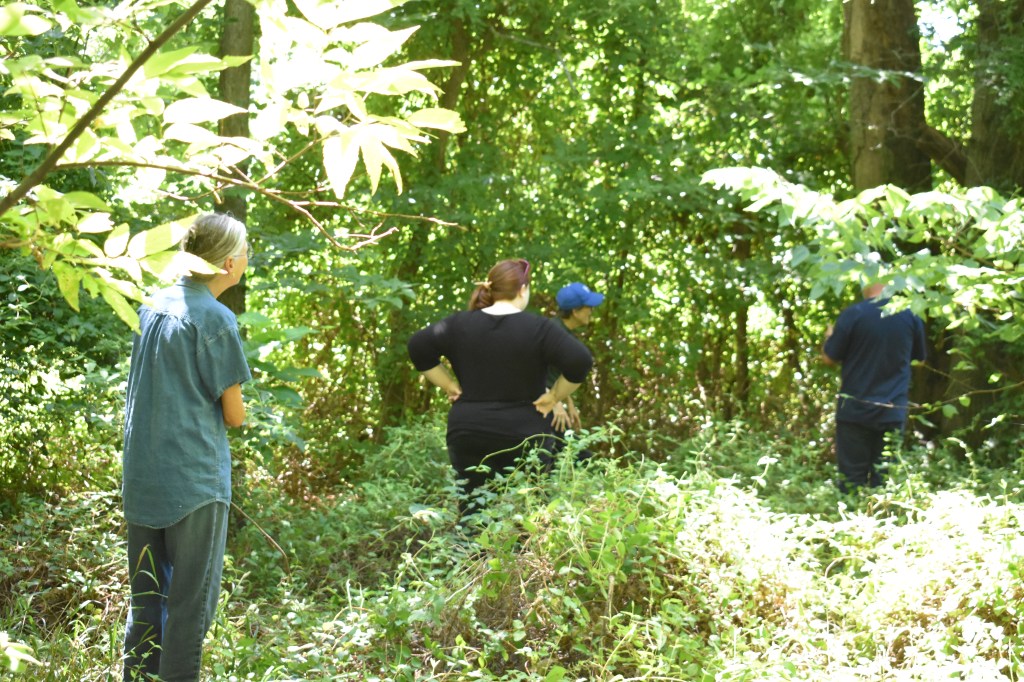
As we scuttled through the underbrush, it was hard not to
notice the spiders. Webs hung from almost every branch that had to be moved in
order to walk forward; it was an unkempt place with a narrow dirt path here and
there, but mostly just hard to navigate brush and vines – and, more spider
webs.
The reason for the excursion was a good one: we were looking
for a freed man’s cemetery in our local area. In the 1830s, a cabin stood just
beyond the place that was identified as a cemetery, and one of the people that
lived in the house that stands there now, was with us. She and her husband had
begun remodeling the house thirty years ago, and in the process uncovered
original timber log siding hidden behind modern walls. But behind the house,
almost two hundred years ago, there was supposedly a stage stop and, beyond
that, a cemetery. The freed man’s cemetery would not have come into existence
except post Civil War, and had in no way been maintained for a long time.
We knew (or were told) that there were not actual headstones in the area. Instead, the folks that buried their dead there had marked their graves with Yucca plants – around these parts, the variety (we assume) was planted was what is natively called a “century plant.” Century plants, contrary to their name, do not live 100 years, but their root systems can. Perhaps the folks that planted them for grave markers thought the plants would bloom in 100 years (another myth about the plant), but the idea is nice.
Among the group of people that accompanied us, was a gentleman who claimed he could use a divining rod to locate the graves. He was a nice fellow and explained he could not be certain, but perhaps the rods would give us an indication of a potential location. Interestingly, he did find a pattern of potential places which, if drawn on a map, would look like the layout of a cemetery. The only real way to be sure, however, would be to excavate the area and look for some archeological evidence.
Our local museum folks, and volunteers, have been busy tracking down the land deed and records, and are also getting names of past people who were be associated with it. Records are sparse: but it is, again, a worthwhile venture. Who knows what will be found?
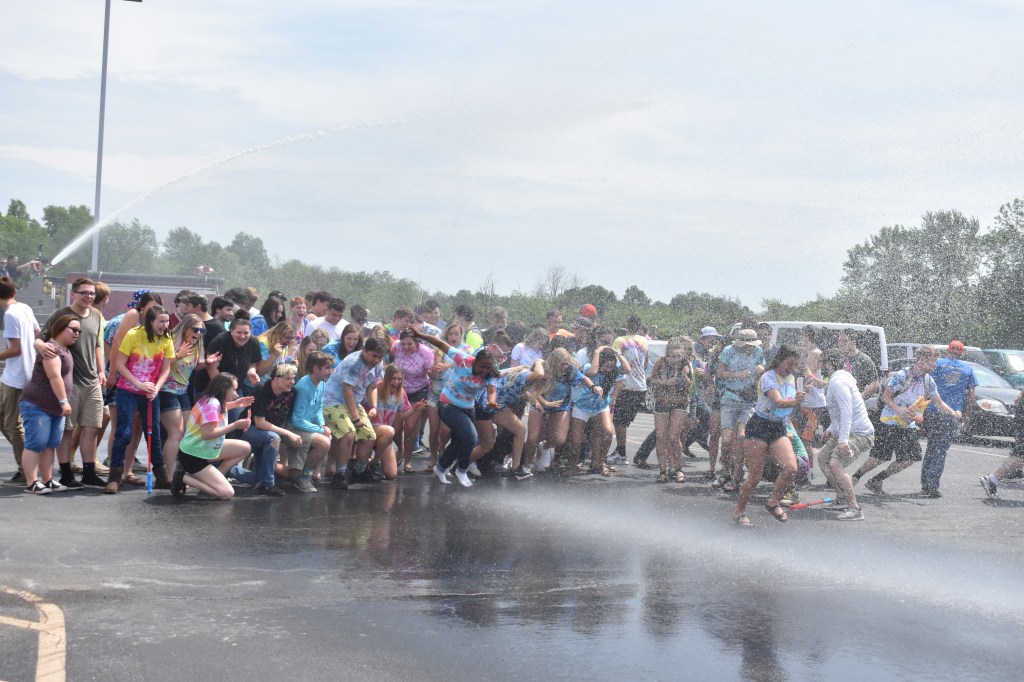
One of my favorite pictures I’ve taken is that of “Senior Send Off.” At our local High School, the Seniors are lured outside by the principal under the pretense of “let me get a group picture,” and the local fire department, behind them, sprays water over them. The effects are comical to say the least – kids run everywhere.
I ran across the photo while looking back through my archives: it made me smile, but it also made me think of kids in general.
For several years now I have written a weekly column (The Printer’s Devil) and I tend to focus on things that happen to me – a large part of which includes what the kids in my own household do. (Yes, I know I have promised to get my “Collected Works” together and publish them, but haven’t had time yet. “Too many irons in the fire” is a daily phrase for me – but, I will get the book formatted and posted for sale at some point folks. Sorry for any delays.)
At any rate, the photo, for some reason, made me think of one of my old columns: “Spell It.”
Spell It
The eight year-old in our home has gotten used to my style and demeanor. As she made her sandwich for school the other morning, I looked at her and proclaimed she had been brought to Earth by aliens. She never even looked up: “Your mom’s an alien,” she said. Good reply. I took it as an encouraging sign.
You see, they say step-children can be a challenge: mine are not so much. I have tried to independently create relationships with them to allow them the freedom to view me however they wish. Mxxy (the eight year-old) has formed the above mentioned type of relationship: she’s a ham. And, she is really is merit based in her motivations at this stage. Way more than I ever was. For instance, the entire house was subjected to the next major undertaking she was to participate in for about a month: the Third Grade Spelling Bee, because she wanted the trophy.
The whole month amused me: I think it might have started to annoy the older kids a little, but me? I thought it was great.
“Okay, spell ‘irrigate,” I said, looking at her list of potential words. “Irrigate. I-r-r-i-g-a-t-e. Irrigate,” she finished. “Good job,” I said. Then I would take a word that was nowhere near the list she had and throw it out to her. “Xylophone,” I said. She is far from stupid. “That’s not on the list,” she informed me. “But, what if it was?” I countered. She attempted to spell it and got it right. “Holy cow,” I thought. “She’s pretty good.” On the car ride to school I threw out “supercalifragilisticexpialidocious” just to see what the reaction would be. She didn’t even acknowledge it but gave me a mock glare. I smiled.
She has adapted quite well over the past couple of years to the influx of people into her life. When my oldest son went off to Basic Training, she wanted to write him a letter. She had formed a nice relationship with him (mainly because he would do whatever she said). She based the letter’s composition off a letter my son had written home which I read aloud to the family.
In it, he said he was made to run a lot (of course) and was kept quite busy doing a myriad of things of which wonderful experience only Basic Training can provide. Like, getting yelled at by drill sergeants, doing pushups, and cleaning things repetitively. She listened attentively as I read the letter.
A few days later, she wrote him back. Before stuffing it into an envelope and sending it off, I read it: “Dear Gxxx, you sound miserable,” she started. She said she thought that the whole thing he was experiencing sounded like a bad idea. She concluded, possibly feeling bad for him, on a positive note: “At least you always have something to do because you are running all the time.” I thought it was a cheerful sentiment. I’m sure my son thought it was encouraging when he finally got to read it.
The spelling bee was the current thing on her mind, however. She practiced, was quizzed multiple times by the whole household, and had her list down to a “T.” She, after I gave her the same word twelve times (even though she spelled it right every time) had “metamorphosis” memorized to the point where she could probably spell it in her sleep.
Everyone gave her valuable suggestions and former spelling bee experiences: “I misspelled “pants,” said one: “I left out the “a.” Other children in the household proclaimed that they wouldn’t make it past the first round in the contest. I gave her the extremely valuable suggestion of how to knock out another student by coughing and saying the wrong letter as another student attempted to spell a word to throw them off. She laughed at it, and, of course, knew I was teasing. I told her the only way I could win it, was by cheating (an exceedingly difficult thing to pull off in a spelling bee).
The day came for the big event. Driving her to school that morning I asked her if she was ready: “Yes,” she said. But, I could tell it was making her nervous. She said her stomach hurt some.
I am a softy. I will laugh and joke with the children all day long. Enjoying children is one of God’s great gifts, when they are not being a pain in the butt, that is. But you have to pick your battles.
“Listen,” I said. “Regardless of whether you win or not, we will go get ice-cream after school. I think that just being selected for the spelling bee was accomplishment enough. So, no matter how it turns out, we will celebrate.”
She agreed that ice cream would be a relevant reward to her efforts, but the thought did not help her stomach much I think. For the eight year old, the spelling bee was the equivalent of an adult taking a very important test. It had some weight. I dropped her off and watched her walk away. The spelling be wasn’t until 1 p.m. It was going to be a long morning for the kiddo.
A little after 1 p.m., I started getting texts from her mother and pictures showing the various kids still left after each round. She was in every one of them as the group size diminished. Now I was getting anxious.
After about a half hour of texts and pictures, she was still in the contest. I wondered what words she was getting. Did they give her xylophone? The teachers, I was informed prior, had a “secret word list” in case the spelling bee wasn’t determined from the given list. My mind raced. I wondered what secret words could be included on a secret list for third graders. Probably stuff I couldn’t even spell. Ugh. What was taking so long?
Then, I got the picture: there she was holding the trophy and first place ribbon. Both the ribbon and trophy were turned around backwards which was comical to my mind. But, she had won it!
As promised, I took her to get ice cream after school. She recounted the whole thing, from start to finish for me. I got a blow-by-blow account of how she took first place (and, how the microphone was too tall for her to speak into). It was glory for her, though. Every detail counted.
And the word that knocked the last kid out of the contest? “Metamorphosis. M-e-t-a-m-o-r-p-h-o-s-i-s. Metamorphosis.” I was happy for her.






 The Imagists