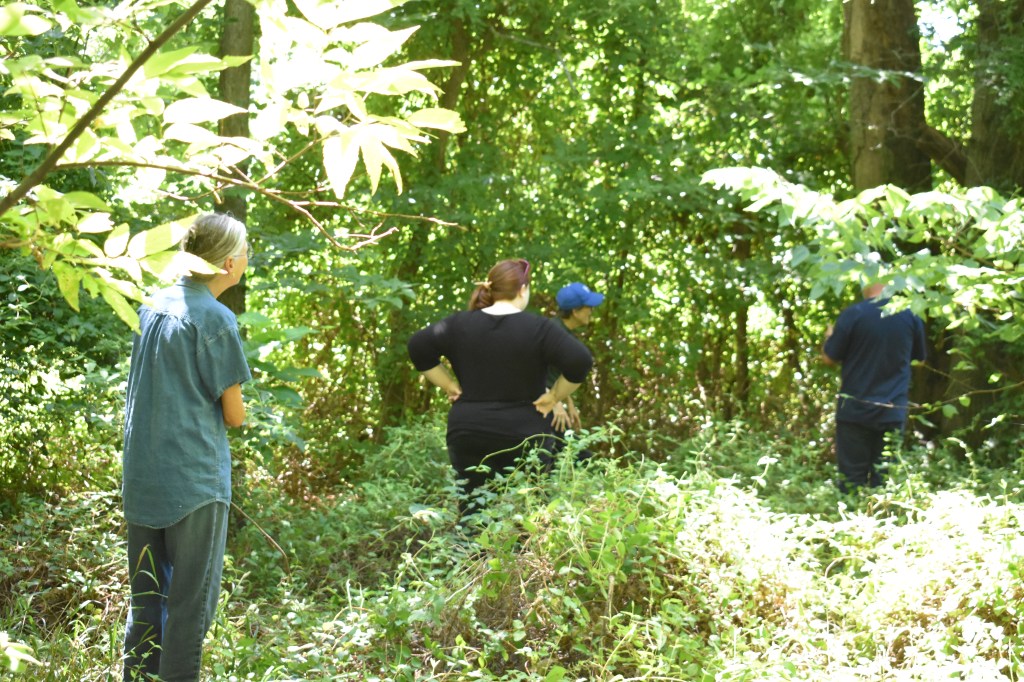
As we scuttled through the underbrush, it was hard not to notice the spiders. Webs hung from almost every branch that had to be moved in order to walk forward; it was an unkempt place with a narrow dirt path here and there, but mostly just hard to navigate brush and vines – and, more spider webs.
The reason for the excursion was a good one: we were looking for a freed man’s cemetery in our local area. In the 1830s, a cabin stood just beyond the place that was identified as a cemetery, and one of the people that lived in the house that stands there now, was with us. She and her husband had begun remodeling the house thirty years ago, and in the process uncovered original timber log siding hidden behind modern walls. But behind the house, almost two hundred years ago, there was supposedly a stage stop and, beyond that, a cemetery. The freed man’s cemetery would not have come into existence except post Civil War, and had in no way been maintained for a long time.
We knew (or were told) that there were not actual headstones in the area. Instead, the folks that buried their dead there had marked their graves with Yucca plants – around these parts, the variety (we assume) was planted was what is natively called a “century plant.” Century plants, contrary to their name, do not live 100 years, but their root systems can. Perhaps the folks that planted them for grave markers thought the plants would bloom in 100 years (another myth about the plant), but the idea is nice.
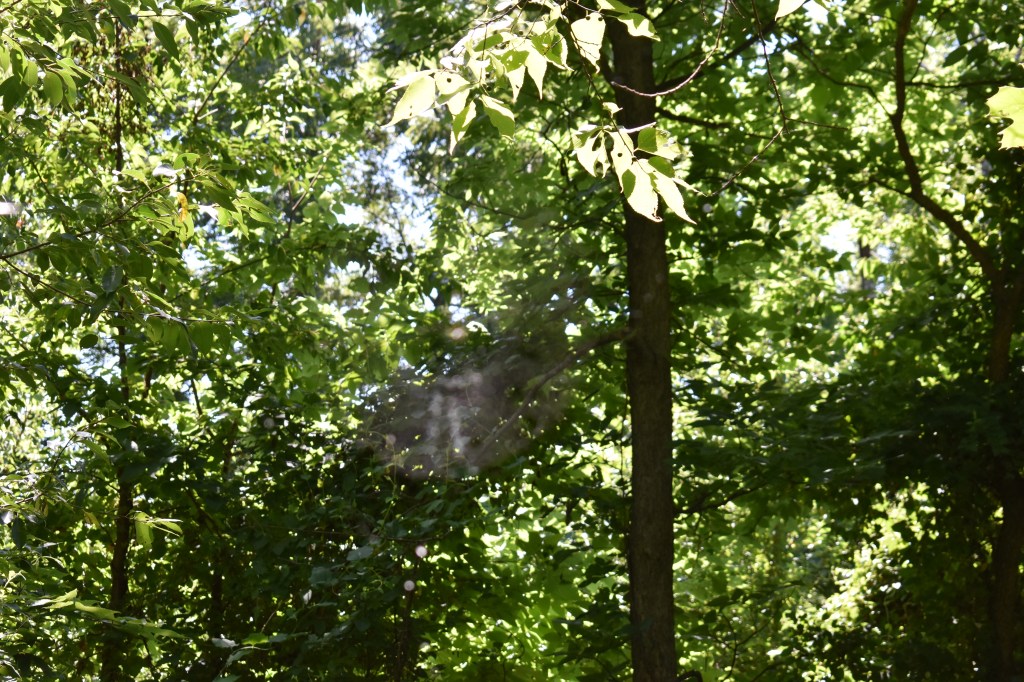
Among the group of people that accompanied us, was a gentleman who claimed he could use a divining rod to locate the graves. He was a nice fellow and explained he could not be certain, but perhaps the rods would give us an indication of a potential location. Interestingly, he did find a pattern of potential places which, if drawn on a map, would look like the layout of a cemetery. The only real way to be sure, however, would be to excavate the area and look for some archeological evidence.
Our local museum folks, and volunteers, have been busy tracking down the land deed and records, and are also getting names of past people who were be associated with it. Records are sparse: but it is, again, a worthwhile venture. Who knows what will be found?
 The Imagists